Sacred Music of Holy Week 2026
O Sacred Head Surrounded
Text: Salve caput cruentatum, Ascribed to Bernard of Clairvaux, 1091 – 1153, abbot, mystic, co-founder of the Knights Templar. From Bernard’s seven passion hymns.
Tune: Passion Chorale, Hans Leo Hassler (Germany, 1564–1612)
Harmony: J. S. Bach (Germany, 1685–1750)
This 12th century hymn has its’ roots in scripture, including Mark 15, John 19, Isaiah 63, Luke 24, Philippians 2, Hebrews 2, Hebrews 5, 1 Peter 3, Matthew 27, John 10, Romans 5, 1 Peter 2, 1 Corinthians 15, 1 Corinthians 16, 2 Corinthians 5, 1 John 4, Isaiah 52 and Isaiah 53.
O Sacred Head, surrounded
By crown of piercing thorn!
O bleeding Head, so wounded,
Reviled and put to scorn!
The pow'r of death comes o'er you,
The glow of life decays,
Yet angel hosts adore you,
And tremble as they gaze.
In this, your bitter passion,
Good Shepherd, think of me
With your most sweet compassion,
Unworthy though I be:
Beneath your cross abiding
For ever would I rest,
In your dear love confiding,
And with your presence blest.
Stations of the Cross, Loretto Chapel, Santa Fe NM - The Passion of the Lord
In stiller Nacht
Arr. Johannes Brahms (Germany, 1833–1897)
Text: Friedrich Spee (1591–1635), a Jesuit priest, and originates from his collection Trutznachtigall.
In stiller Nacht, zur ersten Wacht,
ein Stimm’ begunnt zu klagen,
der nächt’ge Wind hat süß und lind
zu mir den Klang getragen.
Von herben Leid und Traurigkeit
ist mir das Herz zerflossen,
die Blümelein, mit Tränen rein
hab’ ich sie all’ begossen.
In silent night, at first watch,
A voice begins to lament.
The night wind has sweetly and gently
Carried the sound to me.
With bitter pain and sorrow
My heart is melted.
With simple tears and flowers
I have watered all of them.
Der schöne Mond will untergahn,
für Leid nicht mehr mag scheinen,
die Sterne lan ihr Glitzen stahn,
mit mir sie wollen weinen.
Kein Vogelsang noch Freudenklang
man höret in den Lüften,
die wilden Tier’ trauern auch mit mir
in Steinen und in Klüften.
The lovely moon will now set,
For sorrow it doesn’t want to shine,
The stars stop their gleaming,
They want to weep with me.
No birdsong nor joyous sounds
Can be heard in the air.
Even the wild beasts grieve with me
In rocks and ravines.
Brahms in 1866, two years after composing In stiller Nacht
Miserere Mei
Gregorio Allegri (Venice, Italy, 1582–1652)
Text: Psalm 51, David, 10th century B.C.
Allegri was a singer in the Papal Chapel from December 6, 1629, until his death on February 17, 1652. He is almost exclusively known for his 1638 falsobordone setting of Psalm 51 , the Miserere Mei, sung in the Sistine Chapel during Holy Week centuries ago. Most will know this choral work for its haunting top C, sung by one voice in a small choir, and the sweeping harmony of the larger choir, separated by simple plain chant, and that the young Mozart spirited this masterpiece out of the the Sistine Chapel during Holy Week of 1770.
Psalm 51 is one of the most famous psalms in the psalter. The scribes saw fit to tell us this is “A Psalm of David, when Nathan the prophet went to him, after he had gone into Bathsheba.”
This is the lowest point in the life of the King David. He had experienced suffering and the death of his son up to this point in his life. But these tragedies did not compare to the spiritual low point that was his adultery with Bathsheba. Adding to his adultery, he then had her husband murdered, then lied about the whole thing, marrying Bathsheba and acting like nothing ever happened.
David's composition of Psalm 51 is his prayer of remorse.
CHORUS
Miserere mei, Deus,
secundum magnam misericordiam tuam.
Have mercy on me, God,
in accord with your merciful love.
CHANT
Et secundum multitudinem miserationum tuárum,
dele iniquitatèm meam.
In your abundant compassion
blot out my transgressions.
SOLI
Amplius lava me ab iniquitate mea:
et a peccato meo munda me.
Thoroughly wash away my guilt;
and from my sin cleanse me.
CHANT
Quoniam iniquitatem meam ego cognósco:
et peccatum meum contra me èst semper.
For I know my transgressions;
my sin is always before me.
CHORUS
Tibi soli peccavi, et| malum, coram te feci:
ut justificeris in sermonibus tūis, et vincas cum judicaris.
Against you, you alone have I sinned;
I have done what is evil in your eyes.
CHANT
Ecce enim in iniquitatibus conceptus súm:
et in peccatis concepit me matèr mea.
Behold, I was born in guilt,
in sin my mother conceived me.
SOLI
Ecce enim veritatem dilexisti:
incerta et occulta sapientiae tuæ manifestasti mihi.
Behold, you desire true sincerity;
and secretly you teach me wisdom.
CHANT
Asperges me hyssopo, et mundábor:
lavabis me, et super nivem deàlbabor.
Cleanse me with hyssop, that I may be pure; wash me,
and I will be whiter than snow.
CHORUS
Auditui meo dabis gaudium et laetitiam,
et exsultabunt ossa humiliate.
You will let me hear gladness and joy;
the bones you have crushed will rejoice.
CHANT
Averte faciem tuam a peccatis méis:
et omnes iniquitates meàs dele.
Turn your face from my sins;
blot out all my iniquities.
SOLI
Cor mundum crea in me, Deus:
et spiritum rectum innova in visceribus meis.
A clean heart create for me, O God;
renew within me a steadfast spirit.
CHANT
Ne projicias me a facie túa:
et spiritum sanctum tuum ne aufèras a me.
Do not drive me from before your face,
nor take from me your holy spirit.
CHORUS
Redde mihi laetitiam salutaris tui:
et spiritu principali confirma me.
Restore to me the gladness of your salvation;
uphold me with a willing spirit.
CHANT
Docebo iniquos vias túas:
et impii ad te convèrtentur.
I will teach the wicked your ways,
that sinners may return to you.
SOLI
Libera me de sanguinibus, Deus, Deus sa-lutis meæ:
et exsultabit lingua mea justitiam tuam.
Rescue me from violent bloodshed, God, my saving God,
and my tongue will sing joyfully of your justice.
CHANT
Domine, labia mea apéries:
et os meum annuntiabit laudèm tuam.
Lord, you will open my lips;
and my mouth will proclaim your praise.
CHORUS
Quoniam si voluisses sacrificium, dedissem utique:
holocaustis non delectaberis.
For you do not desire sacrifice or I would give it;
a burnt offering you would not accept.
CHANT
Sacrificium Deo spiritus contribulátus:
cor contritum et humiliatum, Deus, non dèspicies.
My sacrifice, O God, is a contrite spirit;
a contrite, humbled heart, O God, you will not scorn.
SOLI
Benigne fac, Domine, in bona voluntate tua Sion:
ut ædificentur muri Jerusalem.
Treat Zion kindly according to your good will;
build up the walls of Jerusalem.
CHORUS
Tunc acceptabis sacrificium justitiæ,
oblateones et holocausta;
Tunc imponent super altare tuum vitulos.
Then you will desire the sacrifices of the just,
burnt offering and whole offerings.
Then they will offer up calves on your altar.
Remember Me
A poem by Christina G. Rossetti (England, 1830 – 1894)
Music: Stephen Chatman (American-born Canadian composer, b. 1950)
Remember me when I am gone away,
Gone far away into the silent land;
When you can no more hold me by the hand,
Nor I half turn to go yet turning stay.
Remember me when no more day by day
You tell me of our future that you plann'd:
Only remember me; you understand
It will be late to counsel then or pray.
Yet if you should forget me for a while
And afterwards remember, do not grieve:
For if the darkness and corruption leave
A vestige of the thoughts that once I had,
Better by far you should forget and smile
Than that you should remember and be sad.
God So Loved the World
Text: John 3:16–17
Setting: Sir John Stainer (England, 1840 – 1901)
Sir John Stainer wrote his setting of “God So Loved the World” as part of his oratorio The Crucifixion (1887).
God so loved the world,
that He gave His only begotten Son,
that whoso believeth in Him
should not perish
but have everlasting life.
God sent not His Son into the world
to condemn the world;
But that the world through Him might be saved. 
Sr. John Stainer
Pie Jesu
Setting: Michael McGlynn (Ireland, b. 1964)
This calming text is the last line of the Requiem Mass' sequence (the Dies Iræ).
Ireland's Michael McGlynn set this ancient sacred text to music following the 1998 Northern Ireland Omagh bombing.
Pie Jesu Domine, dona eis requiem.
Merciful Jesus, grant them eternal rest.
Excerpts from Willam Byrd's Mass for 3 Voices
Willam Byrd (England, c.1540 – 1623)
England’s finest Renaissance composer was a covert Catholic facing brutal prosecution in the English Reformation. He refused to attend Anglican services (which was illegal and punishable). He then further wrote sacred music for secret Catholic masses where Catholic priests and worshippers risked everything for their faith. In 1593 Byrd published the Mass for 3 Voices for clandestine Catholic masses held in private homes.
Byrd’s brilliance shines in this mass - when only three voices are in play, not a single note can go to waste.
Kyrie
This brief invocation and petition is similar to language found in the psalms (Ps. 6 and Ps. 40).
“Kyrie eleison” was a part of the mass in 4th century Jerusalem. “Christe eleison” was added by Pope Gregory I in the 6th century.
Kyrie eleison
Christe eleison
Kyrie eleison
Lord, have mercy
Christ, have mercy
Lord, have mercy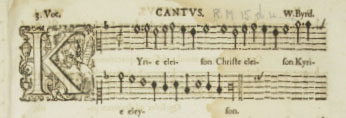
Kyrie from Byrd's Mass for Three Voices
Sanctus and Benedictus
The Sanctus and Benedictus texts are from Old and New Testament scriptures. Isaiah witnesses the seraphim angels crying out Holy, Holy, Holy when he enters the temple. St. Matthew tells of Christ’s triumphant entry into Jerusalem with the crowd chanting Hosanna to the Son of David. The crowd further chanting Psalm 118, blessed is he who comes in the name of the Lord.
The Sanctus was sung following the Preface. The Benedictus immediately followed as the Canon was recited in Latin by the priest.
Sanctus, sanctus, sanctus Dominus Deus Sabaoth:
pleni sunt caeli et terra gloria tua.
Hosanna in excelsis.
Benedictus qui venit in nomine Domini.
Hosanna in excelsis.
Holy, Holy, Holy Lord God of hosts.
Heaven and earth are full of your glory.
Hosanna in the highest.
Blessed is he who comes in the name of the Lord.
Hosanna in the highest.
Agnus Dei
The text of Agnus Dei is from scripture (John 1:25-26, 29). It was incorporated into the mass in the 7th century as a chant to accompany the Fraction (breaking of the bread). When leavened bread was used, this activity took a considerable amount of time.
Agnus Dei, qui tollis peccata mundi, miserere nobis.
Agnus Dei, qui tollis peccata mundi, miserere nobis.
Agnus Dei, qui tollis peccata mundi, dona nobis pacem.
Lamb of God, who takes away the sin of the world, have mercy on us.
Lamb of God, who takes away the sin of the world, have mercy on us.
Lamb of God, who takes away the sin of the world, grant us peace.
Quisquis eris
Michael McGlynn (Ireland, b. 1964)
From the tombstone of James Galwey d. 1627, St. Multose Church, Kinsale, County Cork, Ireland.
Quisquis eris qui transieris,
Perlege, sta, et plora;
Eram ut es, eris ut sum;
Pro me, precor, ora.
Whoever you are who passes by,
Read, stand, and weep;
I was as you are, you will be as I am;
For me, I beg, pray.
Built about 1190, the St. Multose Church is located in what is believed to be the site of the 6th century ecclesiastical settlement of St. Multose, and is considered one of the Church of Ireland's oldest churches. Within the graveyard surrounding the church are graves, mausoleums and monuments from the 16th to 19th centuries, including graves of victims of the RMS Lusitania sinking.
Hacer Esto en Memoria de Mi
Do This in Memory of Me
A Eucharistic hymn of Northern New Mexico
1. O mi grande Señor, dame fe pa' entender
el cariño que tienes por mí.
Porque yo no soy digno para merecer
de tu cuerpo que voy a comer.
1. O my great Lord, grant me faith to understand
the love You hold for me.
For I am not worthy to merit
Your Body, which I am about to receive.
Estribillo
Es tu cuerpo Jesus lo que voy a comer
y tu sangre que voy a beber.
Tu dijiste, Señor poco antes de morir
hacer esto en memoria de mi.
Refrain
It is Your Body, Jesus, that I am about to receive,
and Your Blood that I am about to drink.
You said, Lord, shortly before You died:
"Do this in memory of Me."
2. Yo no sé mi Señor, como te pagaré
el amorque Tú tienes por mi.
Hoy te pido perdón y me entrego total,
quero amarte con más devoción.
2. I do not know, my Lord, how I can repay You
for the love You bear toward me.
Today I ask Your forgiveness and surrender myself completely;
I wish to love You with greater devotion.
3. Si pudiera enten de, el valor de tu amor
te entregara todito mis ser.
Para vivir en ti y que vivas en mí,
en tu gracia yo permanecer.
3. If only I could grasp the true worth of Your love,
I would surrender my entire being to You—
To live within You, and for You to live within me,
that I may abide forever in Your grace.
4. O mi amado Jesús, yo te pido perdón
eres dueño de mi corazón.
Voy a estar más feliz cuando vengas a mi,
es mi vida te lo ofrezco a ti.
4. O my beloved Jesus, I ask Your forgiveness;
You are the Master of my heart.
I shall be truly happy when You come to me;
my very life—I offer it all to You.
5. Dame la inspiración pa’ sequir en Tu plan
quiero amarte con más devoción.
Hoy te ofreces a mí en santa comunión,
buen Jesús dame Tú bendición.
5. Grant me the inspiration to follow Your plan;
I wish to love You with greater devotion.
Today You offer Yourself to me in Holy Communion;
Good Jesus, grant me Your blessing.
The lovely Santa Barbara church in Sile, NM, where Schola first sang Hacer Esto en Memoria de Mi.
Ubi Caritas
Ola Gjeilo (Norway, b.1978)
Since the 10th century, "Ubi Caritas" has been chanted (as a Gregorian chant that likely originated in France) during Holy Week's Holy Thursday Mass. Schola sings this contemporary setting by Norway's Ola Gjeilo.
Ubi caritas et amor, Deus ibi est.
Congregavit nos in unum Christi amor.
Exsultemus, et in ipso jucundemur.
Timeamus, et amemus Deum vivum.
Et ex corde diligamus nos sincero.
Where charity and love are, there God is.
The love of Christ has gathered us into one.
Let us exult, and in Him be joyful.
Let us fear and let us love the living God.
And from a sincere heart let us love each other (and Him).
Come to Me
Ivo Antognini (Switzerland, b.1963)
A poem by Christina G. Rossetti (England, 1830 – 1894)
Published 2019
Antonini set Christina Rossetti’s poem, entitled Echo, in 2019. Echo concerns a person who has lost their beloved long ago, and only through dreams is able to have an echo of what once was, but never will be again. Rossetti wrote "Echo" in 1854 and published it in her first poetry collection, A Goblin Market and Other Poems (1862).
Echo, by Christina Rossetti
Come to me in the silence of the night;
Come in the speaking silence of a dream;
Come with soft rounded cheeks and eyes as bright
As sunlight on a stream;
Come back in tears,
O memory, hope, love of finished years.
O dream how sweet, too sweet, too bitter sweet,
Whose wakening should have been in Paradise,
Where souls brimful of love abide and meet;
Where thirsting longing eyes
Watch the slow door
That opening, letting in, lets out no more.
Yet come to me in dreams, that I may live
My very life again though cold in death:
Come back to me in dreams, that I may give
Pulse for pulse, breath for breath:
Speak low, lean low,
As long ago, my love, how long ago!
Christina Rossetti in 1863, a year after her composing the poem "Echo."
Abenlied
Josef Rheinberger (Bavaria, 1839–1901)
Text: Luke 24 v. 29
Rheinberger composed this six-part setting of Luke's text on March 9, 1855, a few weeks before Easter and only days before his 16th birthday.
Blieb’ bei uns, denn es will Abend warden;
Und der Tag hat sich geneiget, sich geneiget,
O bleib’ bei uns, denn es will Abend earden.
Bide with us, for evening shadows darken,
And the day will soon be over, soon be over,
O bide with us, for evening shadows darken.
Tr. John Rutter (b. 1945)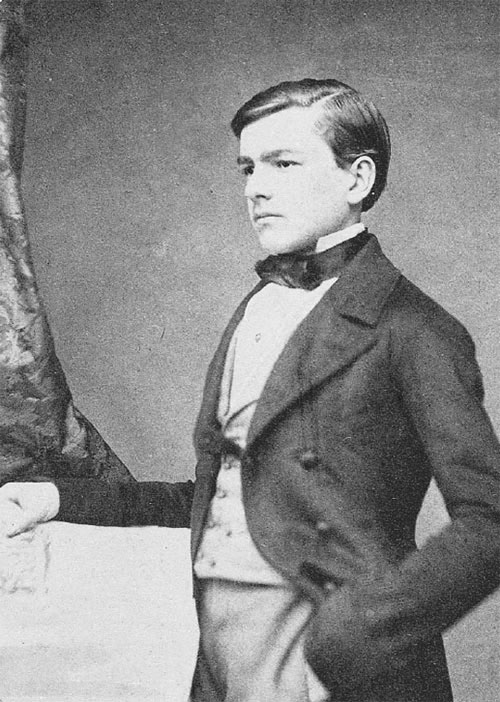
Rheinberger at 16 years of age - one year after he composed Abendlied.
Angelus Domini
Franz Xaver Biebl (Germany, 1906 – 2001)
The praying of the “Angelus” originated in 11th century Europe. As the bells rang in monasteries at dawn, noon and dusk, the custom of chanting the Ave Maria, interspersed with scripture passages, took hold. Biebl composed this setting of the Angelus in 1964 at the request of a choir of firemen in the Fürstenfeldbruck parish near Munich, Germany.
[℣.] Angelus Domini nuntiavit Mariæ;
[℟.] Et concepit de Spiritu Sancto.
[℣.] The Angel of the Lord declared unto Mary
[℟.] And she conceived of the Holy Spirit.
Ave Maria, gratia plena, Dominus tecum.
Benedicta tu in mulieribus,
et benedictus fructus ventris tui, Jesus.
Hail Mary, full of grace, the Lord is with thee.
Blessed art thou amongst women,
and blessed is the fruit of thy womb, Jesus.
[℣.] Ecce ancilla Domini.
[℟.] Fiat mihi secundum verbum tuum.
[℣.] Behold the handmaid of the Lord.
[℟.] Be it done unto me according to your word.
Ave Maria…
[℣.] Et Verbum caro factum est. (In actual practice, here all bow reverently or genuflect.)
[℟.] Et habitavit in nobis.
[℣.] And the Word was made Flesh.
[℟.] And dwelt among us.
Ave Maria…
Sancta Maria, Mater Dei,
ora pro nobis peccatoribus,
nunc, et in hora mortis nostrae.
Amen.
Holy Mary, Mother of God,
pray for us sinners
now and at the hour of our death.
And so it shall be.
Jean-Francois Millet (France, 1814-1875). Millet said of his painting; "The idea for The Angelus came to me because I remembered that my grandmother, hearing the church bell ringing while we were working in the fields, always made us stop work to say the Angelus prayer for the poor departed."
Were You There
Afro-American Spiritual
This spiritual was likely composed by enslaved African Americans in the 19th century.
Were you there when they crucified my Lord?
Were you there when they crucified my Lord?
O sometimes it causes me to tremble! tremble! tremble!
Were you there when they crucified my Lord?
Holy Week 2026 Schola singers
Anna George - alto/tenor
Jackie Mattos - alto/soprano
Denise Moore - soprano
Susan Roller-Whittington - alto/soprano
Lucinda Sydow - alto/soprano
Maestro Billy Turney - baritone